
Electric Water Heaters in Palm Coast, FL
Most Palm Coast houses get their hot water from an electric tank, and when it's time for a new one, the choice is usually between another electric tank, a heat pump water heater, or an electric tankless unit. Here's how an electric tank works, how to read the label on yours, what each upgrade asks of your electrical panel, and what the swap costs.
Why so many homes here are electric
The U.S. Energy Information Administration's 2020 survey of household energy found that 88% of Florida homes heat water mainly with electricity, the highest share of any fuel by far. In Palm Coast the power comes from FPL, which Flagler County's economic development office says serves the entire county. Peoples Gas also lists customers in Flagler County, but whether a gas line reaches a given street is a question for Peoples Gas.
That shapes the options. Without a gas line at the street, a gas tank or gas tankless unit would mean propane delivered to a tank on your property. For most owners the practical comparison is electric tank versus heat pump water heater, with electric tankless as a third option that depends heavily on the panel.
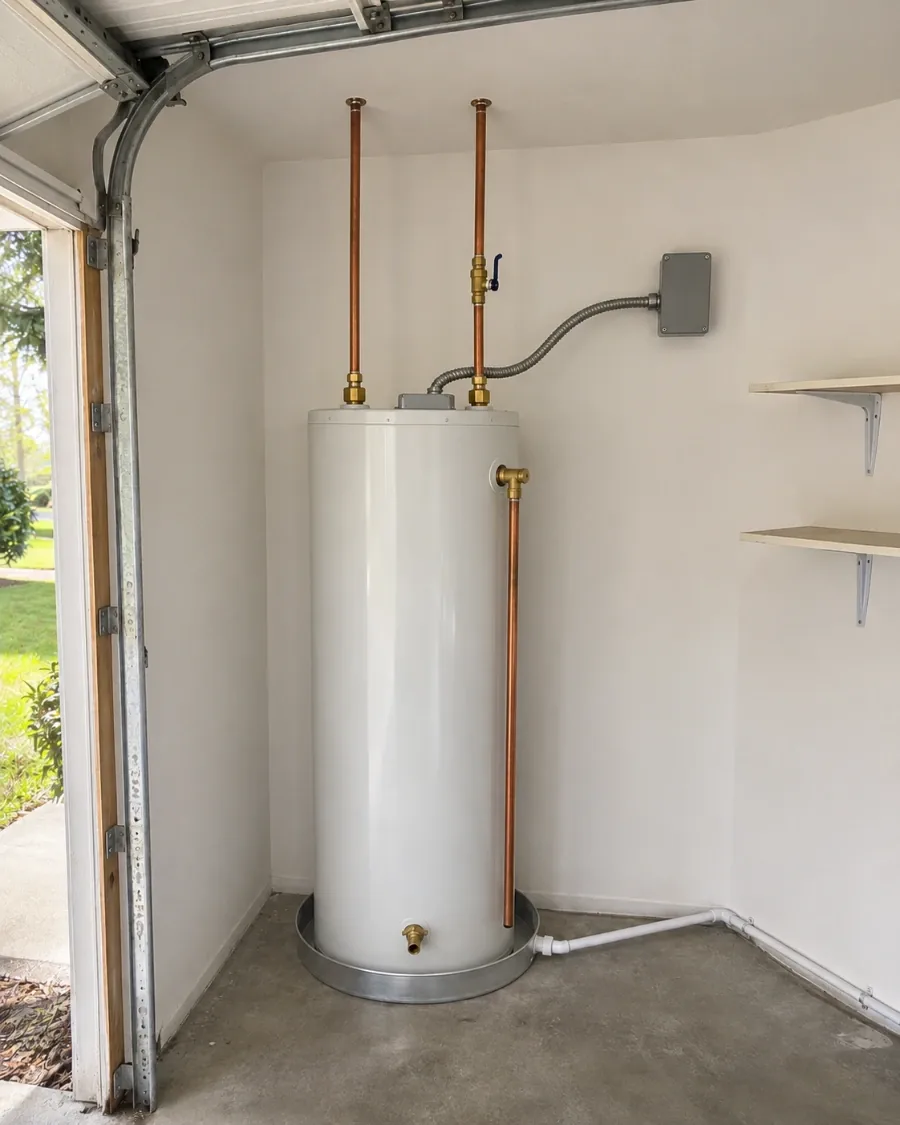
How an electric tank works
Cold water enters through a dip tube that carries it to the bottom of the tank. Heating elements, usually one near the top and one near the bottom, warm the water, each controlled by its own thermostat behind a small access panel on the side. Hot water leaves from the top. A sacrificial anode rod hangs inside and corrodes so the steel tank doesn't, and a relief valve near the top protects against too much temperature or pressure.
Two practical notes from UF/IFAS Extension's 2025 water heater guide: when an electric heater has two thermostats, set both to the same temperature, and 120°F is the best setting for both energy use and everyday function. Its companion guide adds that each 10-degree reduction in the setting cuts water heating energy use by roughly 3% to 5%.
Reading the label: watts, volts and amps
The rating plate on the side of the tank lists the heating element wattage and the voltage. That's enough to work out the current the heater draws, with simple division:
Worked example (assumed label values)
Suppose the plate reads 4,500 watts at 240 volts. Amps = watts ÷ volts, so 4,500 ÷ 240 = 18.75 amps.
Many two-element tanks are wired so only one element heats at a time; the wiring diagram on the tank shows how yours works. The circuit and breaker serving the heater must be sized to the code for that load, which is the installer's job to check. Use your own label's numbers; don't assume these.
This is why a same-type swap is usually simple: the new tank's label typically matches the circuit already in the wall. It's also why switching to an electric tankless unit is a different job entirely (more on that below).
40 gallons or 50?
Capacity isn't the number to shop by. The Department of Energy recommends choosing a storage water heater by its first-hour rating, the gallons it can deliver in one busy hour starting full, and matching that to your household's peak hour within a gallon or two. A 40-gallon unit with a strong first-hour rating can outperform a 50-gallon unit with a weak one. The rating is on the EnergyGuide label and the spec sheet.
If the old tank kept up, the same first-hour rating is a safe target. If showers run lukewarm by the third person, that's the number to raise. See sizing in the replacement guide.
The two upgrade paths for an electric house
Heat pump water heater
A heat pump water heater is a tank with a small heat pump on top that moves heat from the surrounding air into the water. The Department of Energy describes them as two to three times as efficient as conventional electric resistance water heaters, with the potential to cut water heating electricity by 50% or more. In a Florida garage they have a lot going for them, with real conditions attached: enough air space, a condensate drain and a suitable circuit. See heat pump water heaters.
Electric tankless
An electric tankless unit heats water as it flows, so there's no tank to keep warm. The catch is power. Using the same division as above, a 27-kilowatt whole-house unit at 240 volts draws 27,000 ÷ 240 = 112.5 amps. Many homes would need a panel or service upgrade to supply that. UF/IFAS Extension's water heater guide notes "some concern" about using tankless units, gas or electric, in hard-water areas, and says to check with the manufacturer. See tankless water heaters.
What an electric tank swap costs
Thumbtack's 2026 cost guide, citing Xactware data that includes labor and materials, lists $1,355 to $2,022 for a 40-gallon electric tank and $1,459 to $2,177 for a 50-gallon electric tank, nationally. Locally, the contractor's estimated cost on five recent Palm Coast water heater permits for 40- and 50-gallon tanks ran from $1,200 to $2,395. The city's base permit fees on those permits came to $94. See the cost guide.
Electric tanks and storm season
When the power goes out, an electric tank stops heating but still holds its water. FEMA's Ready.gov preparedness guidance has listed a water heater tank as an emergency water source: with the power off, close the cold water inlet, open a hot tap to let air in, and draw water from the drain valve at the bottom. Refill the tank completely before the power comes back on.
If floodwater reached the heater, have it checked before it runs again. FEMA's flood protection guidance recommends raising water heaters and other utilities at least 12 inches above the base flood elevation in flood-prone buildings, which is worth asking about if your garage sits low near a canal.
Electric water heater questions
Why does my electric water heater trip the breaker?
Common causes include a shorted heating element, a failed thermostat or a wiring fault. Leave the breaker off and call; resetting it again and again isn't safe. See repair.
Is it worth replacing a working electric tank with a heat pump unit?
It depends on the tank's age, your electric bill and your garage. Many owners make the switch when the old tank is near the end of its life anyway, so the cost difference is the extra over a plain tank, not the whole price.
Can I put a bigger tank on the same circuit?
Sometimes. What matters is the new unit's wattage and voltage on its label, not the gallons. The installer checks the label against the breaker and wire.
How hot should I set it?
120°F, set the same on both thermostats if there are two. The Consumer Product Safety Commission urges that setting to reduce scald injuries.
Related pages
Sources
- U.S. Energy Information Administration, 2020 Residential Energy Consumption Survey, water heating by state
- Flagler County Department of Economic Opportunity, utilities for site selectors
- UF/IFAS Extension, Energy Efficient Homes: Water Heaters (FY1025, 2025)
- UF/IFAS Living Green, Water Heating
- U.S. Department of Energy, Sizing a New Water Heater (archived copy)
- U.S. Department of Energy, Heat Pump Water Heaters: What You Need to Know (2020)
- Thumbtack, Water Heater Replacement Cost Guide (updated October 23, 2026)
- Ready.gov, Managing Water (archived copy)
- FEMA, Protect Your Property from Flooding
- U.S. Consumer Product Safety Commission, Tap Water Scalds (Document 5098)
- City of Palm Coast permit search (permits we read Nov. 8, 2026)
Replacing an electric water heater in Palm Coast?
Call or send a short request, and it goes to one independent local contractor.