
Leaking Water Heater in Palm Coast? What to Do Right Now
Water around the base of the tank, a wet garage floor, or a stain spreading from the utility closet: a leaking water heater rarely fixes itself, and a small drip can turn into a tank failure. Here's what to shut off first, how to tell a loose fitting from a failed tank, and what the numbers say about older tanks.
Smell gas too? Leave the house. Peoples Gas says to move to safety, call 911, then call Peoples Gas at 877-832-6747. On propane, call 911 and your supplier from outside.
The first ten minutes
- Turn off the power or gas. For an electric heater, switch off its breaker at the panel; it's usually a double breaker labeled for the water heater. For gas, turn the control knob to off, or close the gas valve on the line to the heater.
- Shut off the cold water to the tank. There's normally a valve on the cold line at the top of the heater. If it won't turn or you can't find it, close the main shutoff for the house.
- Protect what's nearby. Move boxes, rugs and anything on the floor. Towels at a doorway keep water from running from the garage into the house.
- Take photos of the water, the tank, the label with its model and serial number, and any damage. If you file a claim, your insurer will want them.
- Call for help. Tell whoever you call what you shut off and where the water seems to be coming from.
Draining the tank yourself isn't required to stop a leak once the water is shut off, and the water inside can still be scalding hot. Leave draining to the contractor unless you're told otherwise.
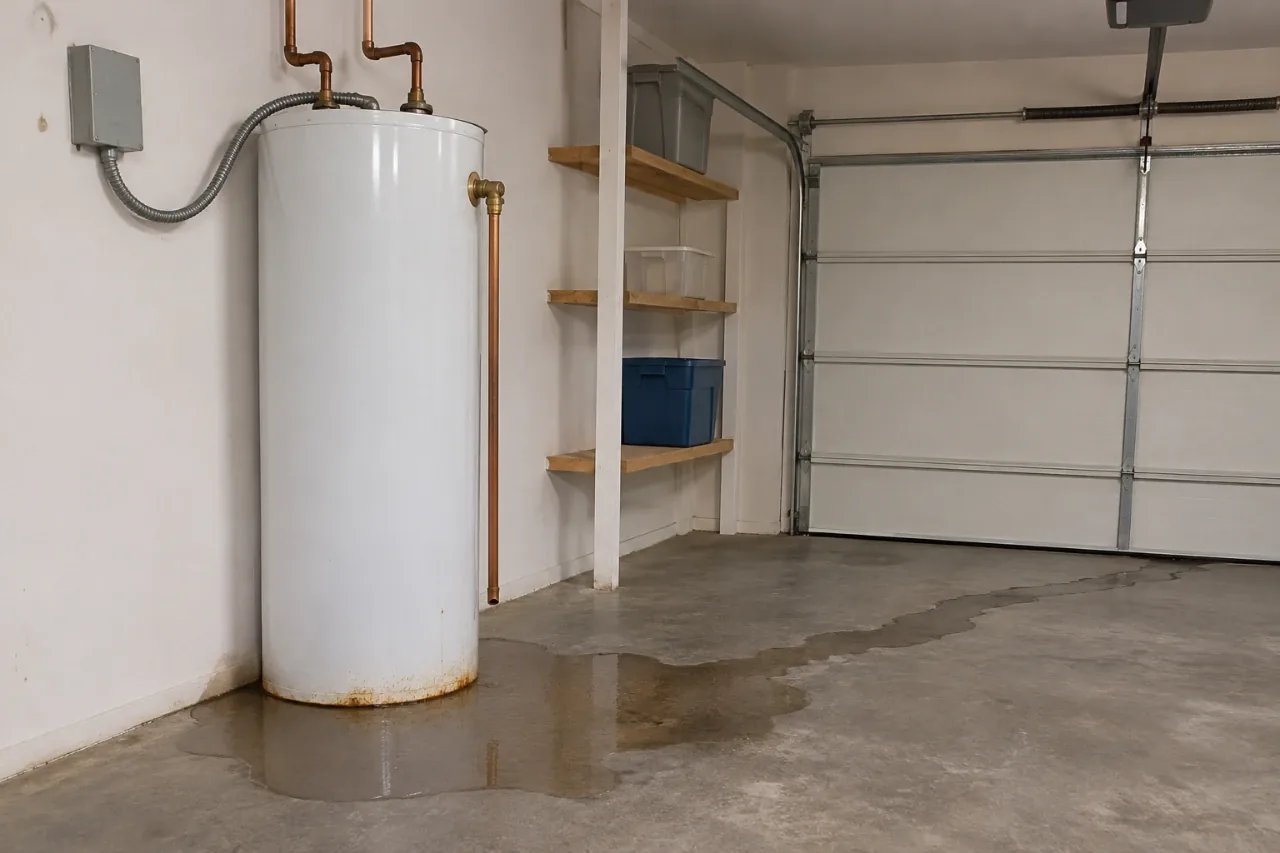
Where the water is coming from
| Where you see water | What it usually means |
|---|---|
| Fittings on top | A loose or corroded connection on the cold or hot line. Often repairable. |
| The relief pipe | The temperature and pressure relief valve is opening or failing. That can mean excess pressure, an overheating tank, or thermal expansion. Never cap or plug the pipe. |
| The drain valve | A drain valve that won't seat fully, sometimes because sediment is caught in it. Often repairable. |
| The base of the tank | Usually the tank itself has rusted through. A tank can't be repaired; it has to be replaced. |
| Under the unit, with a tankless or heat pump model | A fitting, a condensate line that's blocked or disconnected, or an internal leak. |
Water near a heater isn't always from it. Air conditioner condensate lines and the washing machine are often close by, so trace the water back before deciding.
What the numbers say about older tanks
The Insurance Institute for Business & Home Safety (IBHS) puts it plainly in its water damage guidance: the chance a water heater will leak or burst "begins to dramatically increase when it is 5 years old," and three out of four water heaters fail before they are 12 years old. Its advice is a professional look at the anode rod at least every 2 years, yearly once the warranty is up, and flushing sediment every 6 months.
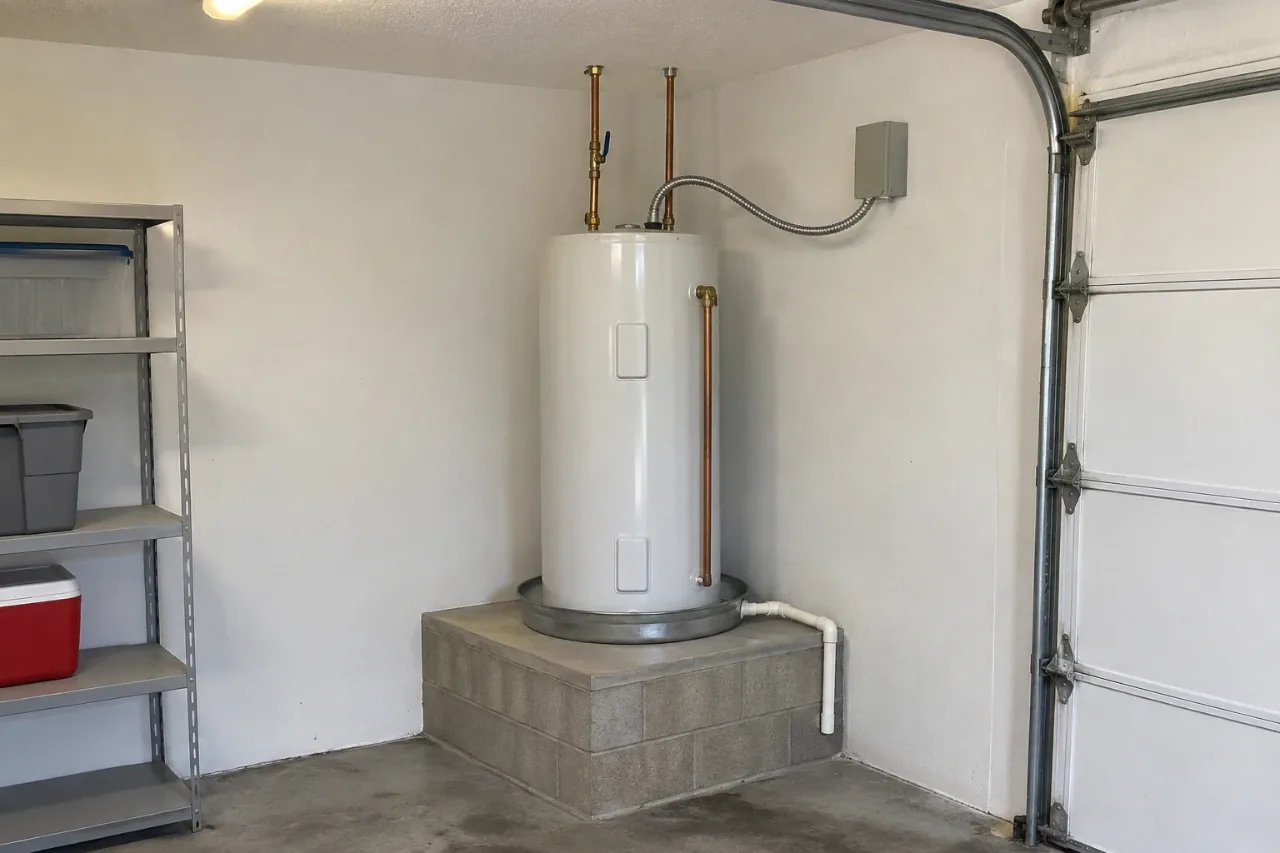
Where the tank sits decides how bad a failure gets. Florida's plumbing code requires a drain pan under a tank-type water heater wherever leakage would cause damage, with a drain that carries the water to a floor drain or outside (Section 504.7 in the 2026 code text), though a replacement heater doesn't need a new pan drain where none was installed before (504.7.2). A pan with a working drain turns a burst into a mess in the garage. A tank with no pan, or a pan whose drain was never connected, sends the water wherever the floor slopes.
Your homeowner's insurance
Whether water damage from a failed water heater is covered, and whether the heater itself is, depends on your policy. Call your agent or carrier, describe what happened, and ask what they need. Keep the photos, and keep the old tank or the parts until you know whether an adjuster wants to see them. A contractor can't decide coverage.
Low garages and storm flooding
Homes along Palm Coast's saltwater canals or near the Intracoastal can get water in the garage from storm surge or heavy rain. If floodwater reached the water heater, have it checked before it runs again. For gas units, Peoples Gas advises having flood- or storm-affected equipment inspected and serviced by a qualified plumber or appliance-service contractor before use.
If you're replacing a heater in a flood-prone garage anyway, ask about height. FEMA's flood protection guidance recommends raising water heaters and other utilities at least 12 inches above the base flood elevation, on masonry, concrete or pressure-treated lumber. Your flood zone and base flood elevation are on your property's flood map or elevation certificate.
Leak questions
Can a leaking water heater explode?
The relief valve exists to prevent a dangerous buildup of temperature and pressure, which is why it should never be capped or blocked. A leak from the tank's base is a different problem: the steel has rusted through, and it tends to get worse.
Is it safe to keep using it until it's replaced?
If the leak is from the tank itself, no: shut it off. If it's a fitting on top, a contractor may be able to tighten or replace it. Ask before turning it back on.
Do I need a permit for an emergency replacement?
Palm Coast issues water heater change-outs as permits with a plumbing final inspection. Ask the contractor how they handle the permit when the job can't wait. See permits.
The pan is full but the floor is dry. Is that a leak?
Yes, water is getting out somewhere, and the pan caught it. Check that the pan's drain line isn't blocked, and find the source before the pan overflows.
Related pages
Sources
- Insurance Institute for Business & Home Safety, water damage prevention pamphlet, undated (via the Connecticut Insurance Department)
- International Code Council, Florida Building Code, Plumbing, 9th Edition (2026), Chapter 5 sample
- Peoples Gas, As recovery begins, Peoples Gas wants residents to stay safe (September 27, 2024)
- FEMA, Protect Your Property from Flooding
Water heater leaking now?
Call and say it's leaking. Your call goes to one independent local contractor in the Palm Coast area.