
Water Heater Replacement in Palm Coast, FL
Thinking about water heater replacement in Palm Coast before the old tank decides for you? This guide walks through the signs a tank is near the end, how to size the new one, what changes when you switch to a different type, the safety parts Florida's plumbing code calls for, and what the city's permit and inspection add to the day.
When it's time to replace, not repair
Age is the first thing to check. The label on the side of the tank carries a manufacture date, sometimes inside the serial number. UF/IFAS Extension says most water heaters last 10 to 15 years, and its guide notes that swapping out a unit older than 10 years can pay for itself through lower utility bills. The Insurance Institute for Business & Home Safety (IBHS) is blunter: three out of four water heaters fail before they reach 12, and the odds of a leak or burst climb sharply once a tank is 5 years old.
Beyond age, these point toward replacement rather than another repair:
- Water seeping from the tank itself, rather than from a valve or pipe connection. A steel tank that leaks through its wall can't be patched. See leaking water heater.
- Rust at the base or rusty hot water that doesn't clear after running the tap, when the cold water runs clean.
- Repeated repairs on an older unit: a second set of heating elements, another thermostat, another relief valve.
- A household that has outgrown it. If the hot water runs out every morning, a repair won't add gallons.
If the tank is young and the trouble is a part, a repair often makes more sense. A good contractor will say which way they'd go and why.
Sizing the new one
Gallons on the label aren't the best guide. The Department of Energy sizes storage and heat pump water heaters by their first-hour rating: how many gallons of hot water the unit can deliver in an hour starting from a full tank. Its method is to estimate your household's busiest hour (showers back to back, a dishwasher, a load of laundry) and pick a model whose first-hour rating lands within a gallon or two of that number. The rating is printed on the yellow EnergyGuide label and in the spec sheet.
Two practical checks in a Palm Coast house:
- Will it fit where the old one sat? Measure before you shop: a new tank of the same capacity isn't always the same size as the old one, and heat pump models run taller. A utility closet with a door frame leaves less room to play with than a garage corner.
- Is your household's routine changing? Grandkids staying for the winter, a soaking tub, or someone working from home shifts the busiest hour. Mention it when you call.
Tankless units are sized differently, by gallons per minute at a given temperature rise. The tankless guide shows that math.
Same type again, or something different?
A like-for-like swap is the simplest job: the same fuel, a similar size, the same spot, the same circuit or gas line. Of the five recent Palm Coast water heater permits we opened, three described electric tanks, two of them as same-for-same change-outs. Switching types adds work, and it's worth knowing what before you get a price:
| Switching to | What usually changes |
|---|---|
| Heat pump water heater | A taller unit, enough air around it, a condensate drain line, and a circuit that matches the model's label. See heat pump water heaters. |
| Electric tankless | Much larger wiring and breakers, and often a panel or service upgrade. See tankless. |
| Gas or propane tankless | A gas line sized for a large burner, a new vent through the wall or roof, and a power outlet for the controls. See gas and propane. |
| Moving the location | New water lines, a new drain path for the pan and relief pipe, and possibly a new circuit or gas run. Any of those can change which permits apply. |
The safety parts the code asks for
A replacement is a chance to correct things the old install may have gotten wrong. The water heater chapter of the Florida Building Code, Plumbing spells them out. The wording below is from the code's 2026 edition, which the International Code Council publishes and which takes effect in Florida on December 31, 2026. Until then the 8th Edition (2023) applies, and the edition is set by when the permit application is submitted; ask Building Services which applies to yours.
The relief valve and its pipe
Every tank has a temperature and pressure relief valve near the top, the last line of defense if the thermostat fails. Section 504.6 lists how its discharge pipe must run. Among other things, the pipe can't be smaller than the valve outlet, has to flow downhill by gravity with no trap, can't have a valve, tee or threaded end, must end where people in the house would notice it, and must end no more than 6 inches above the floor or pan. The point is that a hot discharge goes somewhere safe and visible instead of being hidden or blocked.
The drain pan
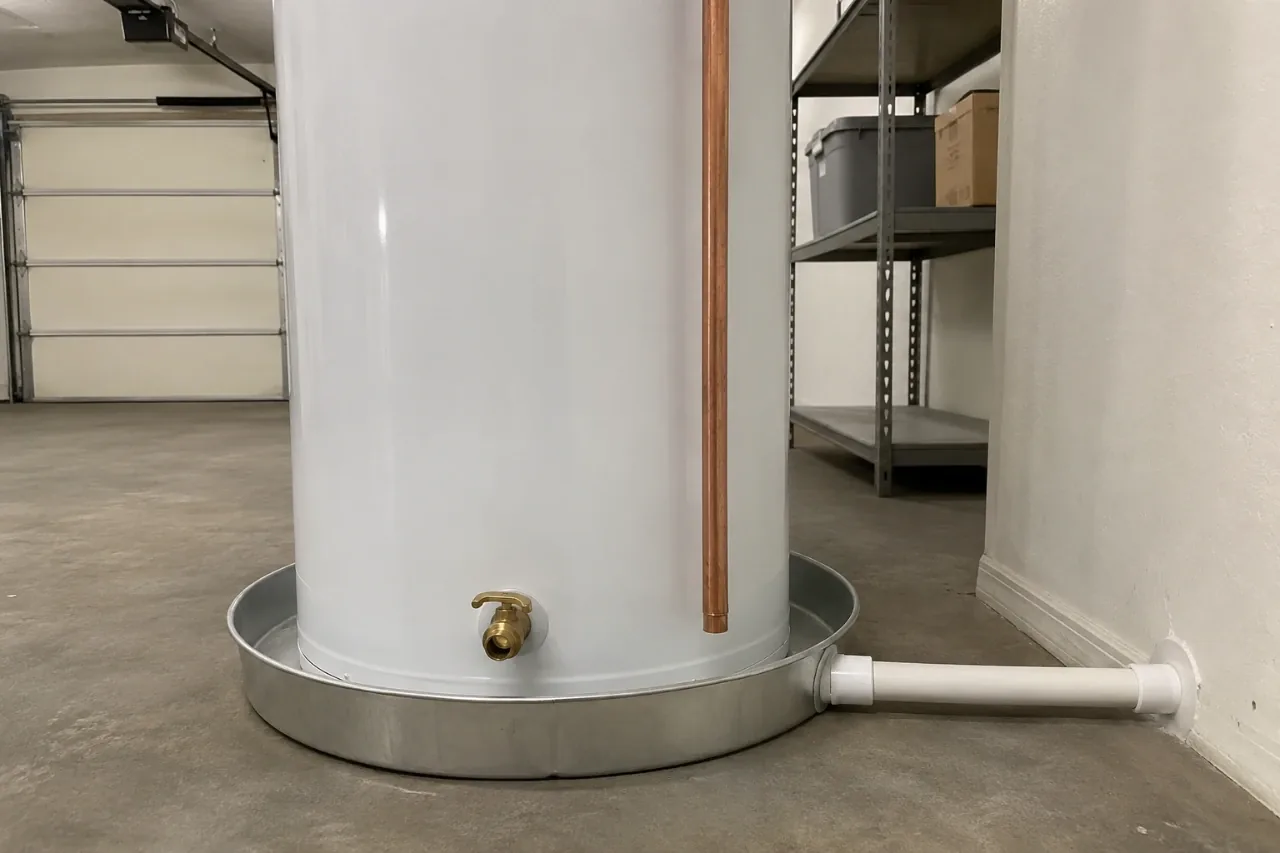
Section 504.7 requires a pan under a tank-type water heater wherever a leak would cause damage. The pan must be at least 1½ inches deep, drained by a pipe at least ¾ inch across, and that drain has to end over a floor drain or similar receptor, or outdoors between 6 and 24 inches above the ground. One exception matters for replacements: where no pan drain was installed before, the code doesn't require one for a replacement water heater (Section 504.7.2), though the pan itself is still required where a leak would cause damage. A plastic pan can't go under a gas-fired unit. In a garage, a pan with a working drain is the difference between a puddle and water spreading under the door to the house.
Thermal expansion
Water expands as it heats. Section 504.4 says the relief valve can't be used as the way to handle that expansion. Where water can't flow back toward the street because of a check valve or backflow device on the service line, a small expansion tank on the cold line gives that water somewhere to go. Ask whether your house needs one; Angi (2025 data) lists $90 to $350 for an expansion tank.
What install day looks like
- Shutoff and drain. Power off at the breaker (or gas off at the appliance valve), cold water off, then the old tank is drained through a hose, usually to the driveway or yard.
- Out with the old. The old tank is disconnected and hauled away. Thumbtack (updated Oct. 23, 2026) puts haul-away at around $100 when it's priced separately.
- Set the new unit. New pan and drain if needed, the tank set in place, water connections made, and the relief pipe run to code.
- Fill before power. An electric tank is filled completely, with air bled out at a hot tap, before the breaker goes back on, so the heating elements are under water when they first get power.
- Set the temperature. Ask for 120°F, the setting the Consumer Product Safety Commission recommends to cut scald risk.
- Inspection. The city's plumbing final comes later. On the five recent Palm Coast permits we read, three failed the first inspection and passed on a second visit, so ask who handles corrections.
What it costs
Palm Coast's permit records give a local anchor: the median job value on 2025 water heater permits was $2,000, by our November 6, 2026 count of the city's permit search, and the contractor's estimated cost on five recent 40- and 50-gallon tank permits ran from $1,200 to $2,395. National guides put the average range at $748 to $2,138 (Thumbtack, updated October 23, 2026). Those are records and national figures, not a quote for your house. The cost guide breaks the numbers down by type.
Replacement questions
Can a water heater be replaced in one day?
A same-type swap usually can. Switching to tankless or a heat pump unit, or moving the heater, can take longer if electrical, gas or drain work comes with it. The city's plumbing final happens after the install, on its own schedule.
Should I replace a 12-year-old tank that still works?
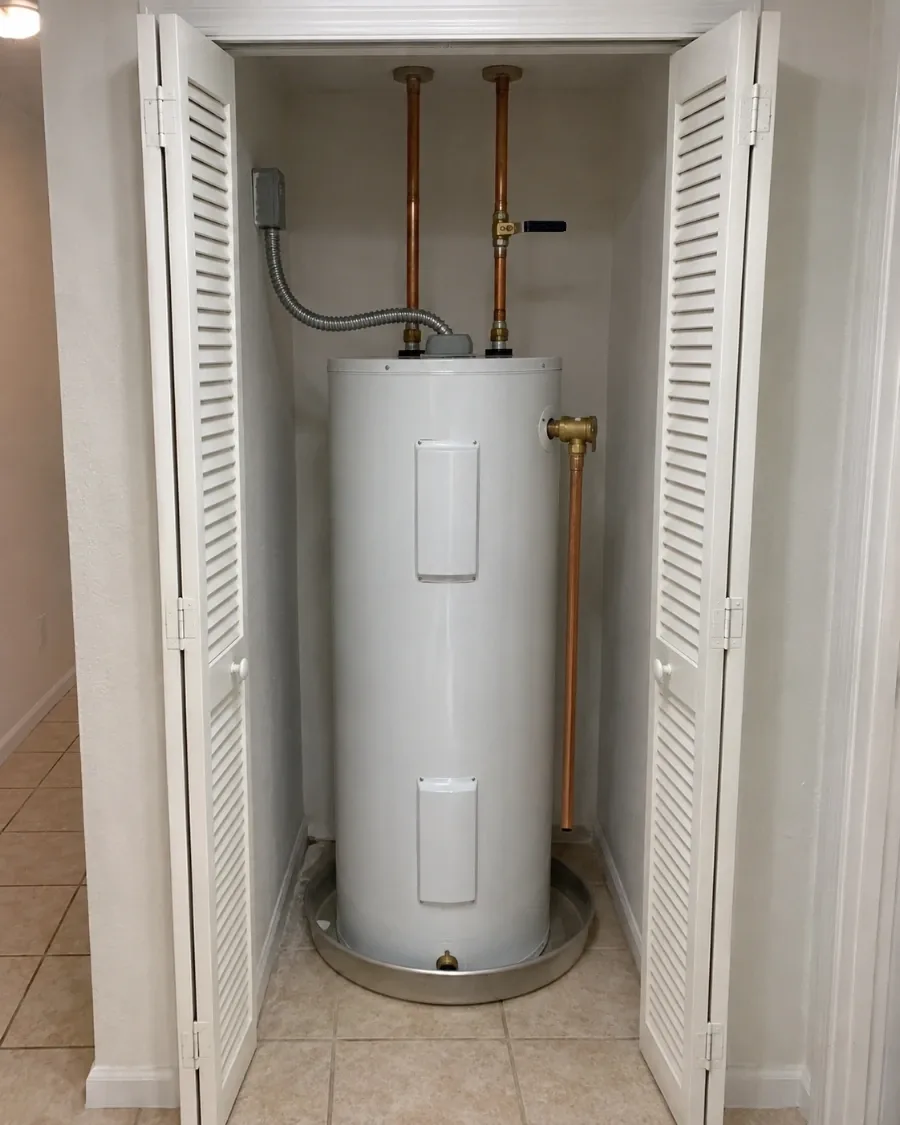
It's your call, and many people wait. Weigh it against the IBHS finding that three in four tanks fail before 12, and against where the tank sits. A failure in a garage with a drained pan is a mess; a failure in a closet off carpeted rooms is a claim.
Do I need a bigger tank than the one I have?
Only if your busiest hour has grown past the old tank's first-hour rating. The DOE's method is to match the rating to that peak hour, within a gallon or two.
What happens to the old water heater?
Most installers haul it away as part of the job. Ask whether that's in the price.
Sources
- UF/IFAS Extension, Energy Efficient Homes: Water Heaters (FY1025, 2025)
- Insurance Institute for Business & Home Safety, water damage prevention pamphlet, undated (via the Connecticut Insurance Department)
- U.S. Department of Energy, Sizing a New Water Heater (archived copy)
- International Code Council, Florida Building Code, Plumbing, 9th Edition (2026), Chapter 5 sample
- Miami-Dade County, notice that the 2026 Florida Building Code takes effect December 31, 2026
- U.S. Consumer Product Safety Commission, Tap Water Scalds (Document 5098)
- Thumbtack, Water Heater Replacement Cost Guide (updated October 23, 2026)
- Angi, water heater installation cost (2025 data)
- City of Palm Coast permit search (our Nov. 6, 2026 count, and permits we read Nov. 8, 2026)
Ready to replace your water heater?
Call or send a short request, and it goes to one independent local contractor in Flagler County.