
Tankless Water Heaters in Palm Coast, FL
A tankless water heater in Palm Coast can mean two very different jobs. A gas or propane unit needs a fuel line and a vent. An electric whole-house unit needs a lot of electrical capacity, often more than the house has. This guide works through the amps, the flow you can expect, the scale question on city water, and what it costs, with every assumption written out.
How tankless works, and what it gives up
A tankless unit heats water only while a hot tap is open. Water passes through a heat exchanger, a burner or electric elements fire, and hot water comes out the other side. Nothing sits in a tank losing heat overnight, and the unit takes up a patch of wall instead of a corner of the floor.
The trade-off is that a tankless unit has a ceiling on how much hot water it can make at once. A tank stores 40 or 50 gallons for a rush; a tankless unit has to keep up in real time. Sizing it right is the whole job, and the next two sections show how.
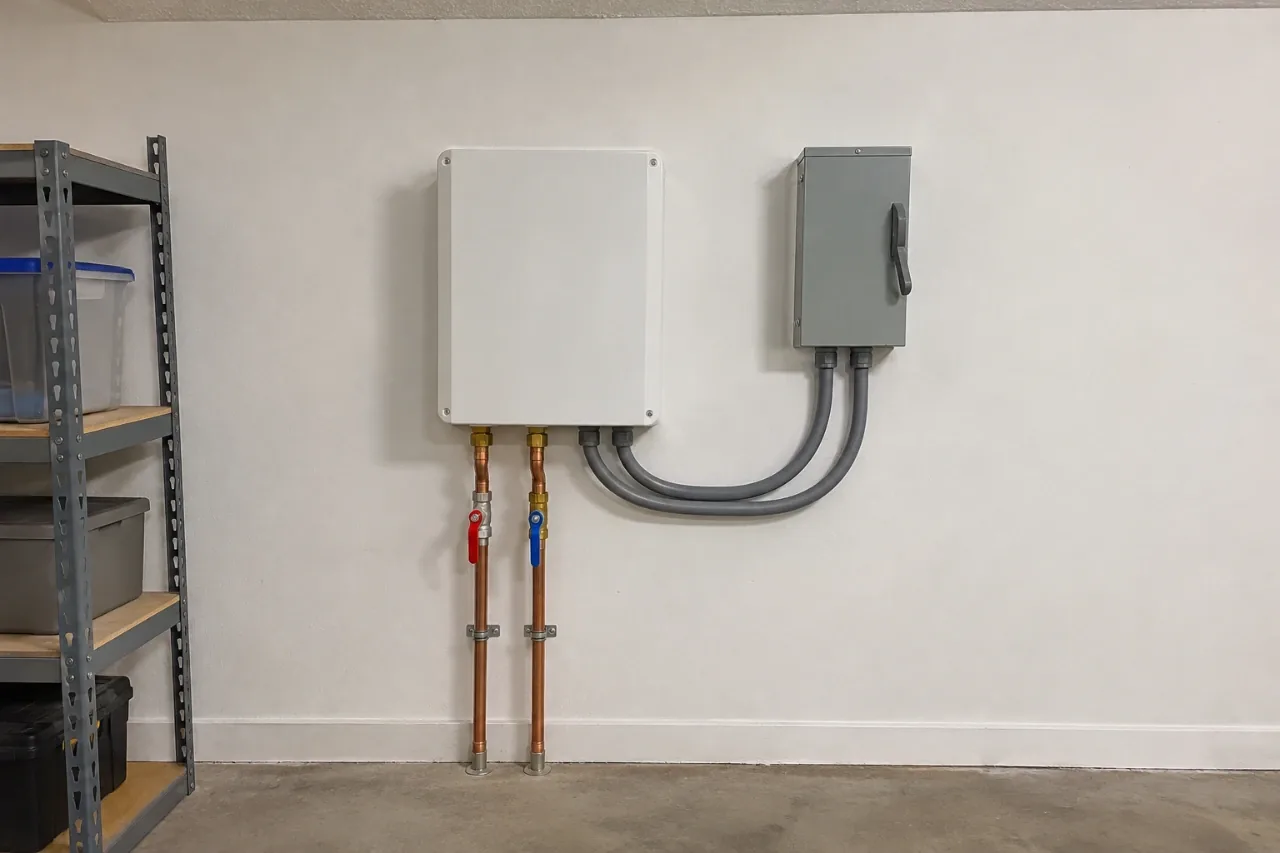
Electric tankless: the amps come first
In a house without natural gas or propane, and 88% of Florida homes heat water with electricity according to the U.S. Energy Information Administration, tankless means electric. Electric units are rated in kilowatts, and the current they draw is simple arithmetic: amps = watts ÷ volts. At 240 volts:
| Unit size | Math | Current drawn |
|---|---|---|
| 18 kW | 18,000 ÷ 240 | 75 amps |
| 27 kW | 27,000 ÷ 240 | 112.5 amps |
| 36 kW | 36,000 ÷ 240 | 150 amps |
For comparison, the label on a typical electric tank might read 4,500 watts, or 18.75 amps. A whole-house tankless unit asks for several times that, through multiple heavy circuits. Before anything else, the contractor has to confirm your panel and service can carry it alongside the air conditioning, range and dryer. If they can't, the price of a panel or service upgrade belongs in the comparison.
How much hot water you actually get
A standard rule of thumb: raising one gallon per minute of water by 1°F takes about 500 BTU per hour (a gallon weighs about 8.33 pounds, times 60 minutes). One kilowatt equals 3,412 BTU per hour. So the flow a unit can deliver depends on how much it has to raise the water's temperature.
Worked example: a 27 kW electric unit
27 kW × 3,412 = 92,124 BTU per hour. Flow = 92,124 ÷ (500 × temperature rise). Target output: 120°F.
- Incoming water at 50°F (a 70-degree rise): about 2.6 gallons per minute
- Incoming at 60°F (a 60-degree rise): about 3.1 gpm
- Incoming at 70°F (a 50-degree rise): about 3.7 gpm
The Department of Energy's sizing method says to assume 50°F incoming water unless you know otherwise, and to add up the flow of everything you'd run at once. The EPA notes that a standard showerhead uses 2.5 gallons per minute, while WaterSense-labeled heads use 2.0 or less. Two standard showers at once need 5 gpm, more than this unit makes at any of the three temperatures above. One shower plus a bathroom faucet is closer to its range. Ask the contractor to size for your coldest incoming water, not an average day.
Gas and propane tankless
Gas units deliver far more heat per unit than electric ones, which is why they're the usual whole-house choice where gas is available. In Flagler County that means a Peoples Gas line, where one reaches your street, or propane from a tank on the property. Either way, the job usually includes:
- Gas piping sized for the burner. A tankless burner can use far more gas at once than a tank did, so the line from the meter or regulator is checked and sometimes replaced.
- A vent of its own, through a wall or the roof, run to the maker's limits on length and bends. A unit that can't exhaust properly shuts itself down.
- Electricity. Gas tankless units need power for their controls and fan, so they don't make hot water during a power outage unless they're on backup power.
See gas and propane water heaters for supply and safety details.
Scale on Palm Coast water
The City of Palm Coast's 2025 water quality report lists total hardness of 100 parts per million, or 5.8 grains per gallon. On the scale published on the U.S. Geological Survey's website, 61 to 120 milligrams per liter counts as "moderately hard." Hardness minerals build up as scale inside a tankless heat exchanger, which cuts flow and can trigger error codes over time.
UF/IFAS Extension's water heater guide notes "some concern" about using tankless units, gas or electric, in hard-water areas, and says to check with the manufacturer. In practice, ask two things before buying: what the maker's manual says about water hardness for that model, and how often it calls for descaling. Plan for service valves on the unit so flushing is a routine job. See Palm Coast water.
What tankless costs
National figures, labeled as national: Angi (2025 data) lists $1,400 to $3,900 for a tankless water heater installed, with tankless replacement labor at $600 to $1,900 and labor to convert from a tank anywhere from $150 to $2,500. Thumbtack's 2026 guide gives an average range of $747 to $2,312 for tankless. Angi lists panel and gas work as extra costs: $500 to $1,000 for a new electrical line and sub-panel and $260 to $820 for gas line installation (2025 data), with no figure for a full service upgrade.
The federal energy efficient home improvement credit no longer helps here. The IRS instructions for Form 5695 say the credit is allowed for property placed in service through December 31, 2025.
When tankless fits, and when it doesn't
Often a good fit
- Gas or propane is already in the house.
- A small household that rarely runs two showers at once.
- You want the floor space in a closet or garage back.
- A dedicated point-of-use need, like a far-off bathroom.
Think twice when
- The house is all-electric and the panel is already busy.
- Several people shower back to back every morning.
- You want hot water during power outages.
- A heat pump tank would meet the same efficiency goal with less electrical work.
Tankless questions
Will an electric tankless unit run two showers?
Usually not at full flow. In the worked example, a 27 kW unit makes about 2.6 to 3.7 gallons per minute depending on incoming water temperature, and two standard showers take 5. Low-flow heads and warmer water help, but check the math with your own numbers.
Do I need a bigger electrical panel?
Often, for a whole-house electric unit. At 240 volts, a 27 kW unit draws 112.5 amps by itself. The contractor has to calculate your panel's load before quoting.
Does tankless work during a power outage?
No. Electric units need power to heat, and gas units need power for their controls and fan.
How often should a tankless unit be flushed?
Follow the manufacturer's schedule for your water. Palm Coast's city water is moderately hard at 5.8 grains per gallon, so scale does build over time.
Related pages
Sources
- U.S. Department of Energy, Sizing a New Water Heater (archived copy)
- U.S. EPA WaterSense, showerheads fact sheet
- City of Palm Coast, 2025 Annual Water Quality Report
- U.S. Geological Survey, water hardness FAQ
- UF/IFAS Extension, Energy Efficient Homes: Water Heaters (FY1025, 2025)
- Angi, water heater installation cost (2025 data)
- Thumbtack, Water Heater Replacement Cost Guide (updated October 23, 2026)
- IRS, Instructions for Form 5695 (2025)
- U.S. Energy Information Administration, 2020 RECS, water heating by state
Weighing tankless for your Palm Coast home?
Call or send a short request, and one independent local contractor can look at your panel or gas line and give you a written price.