
Palm Coast Tap Water and Your Water Heater
What comes out of the tap in Palm Coast shapes how long a water heater lasts and how much care it needs. The city's 2025 water quality report gives the numbers: where the water comes from, how it's treated, and how hard it is. Here's what those figures mean for a tank, a tankless unit and a heat pump water heater.
Where Palm Coast's water comes from
The City of Palm Coast Utility draws groundwater from wells in the surficial and Floridan aquifers, according to its 2025 annual water quality report. The report describes 66 wells in one place and refers to "sixty-nine wells" in another, and lists three treatment facilities. Treatment includes lime softening, membrane softening, filtration, forced draft aeration, corrosion control and chloramination. The city's water quality page describes Water Treatment Plant 1 as a conventional lime-softening and filtration plant.
If you're in Bunnell, Flagler Beach or elsewhere in the county, or on a private well, your water has its own numbers. Ask your utility for its report, or have a well tested.
Hardness: 5.8 grains per gallon
- Total hardness
- 100 parts per million, or 5.8 grains per gallon (2025 report)
- Calcium hardness
- 80 parts per million, or 4.7 grains per gallon (2025 report)
- Where that falls
- "Moderately hard," the 61 to 120 milligrams per liter band on the scale published on the U.S. Geological Survey's website. Parts per million and milligrams per liter are effectively the same unit for water.
The city softens its water at the plants, and what reaches the tap lands in the moderately hard band. That water still carries minerals that come out of solution when it's heated. In a tank they settle as sediment on the bottom. In a tankless unit they coat the heat exchanger as scale.
What it means for a tank
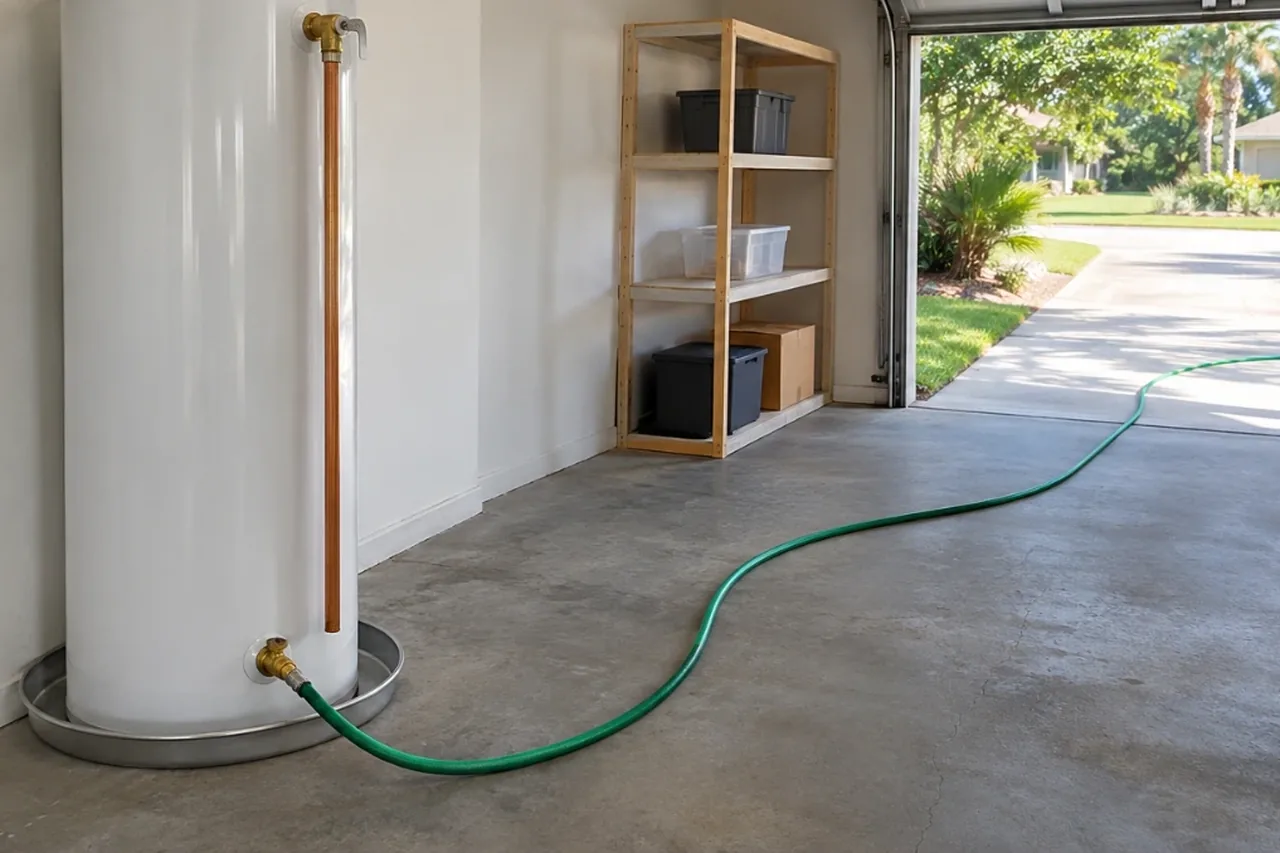
Sediment on the bottom of a tank causes popping or rumbling as it heats and takes up room that should hold hot water. The Insurance Institute for Business & Home Safety advises flushing the tank every 6 months to remove sediment, adding that sediment builds faster in hard water.
The other part to watch is the anode rod, a metal rod inside the tank that corrodes on purpose so the steel tank doesn't. IBHS recommends a professional inspection of the anode rod at least every 2 years, and every year once the warranty has expired, because once the rod is used up the tank is left open to corrosion. Replacing a worn anode on a healthy tank is ordinary maintenance.
What it means for tankless
Scale is the main maintenance issue for any tankless unit. It narrows the heat exchanger, cuts flow and can set off error codes. UF/IFAS Extension's water heater guide notes "some concern" about using tankless units, gas or electric, in hard-water areas, and says to check with the manufacturer. With Palm Coast's water in the moderately hard range, the practical steps are:
- Read the maker's water quality limits for the model before buying.
- Follow its descaling schedule, and plan for isolation valves at the unit so flushing is a routine visit.
- Clean the inlet screen or filter when the unit is serviced.
Chloramine, and the occasional chlorine switch
Palm Coast disinfects with chloramine. The 2025 report lists a combined chlorine and chloramine level of 3.38 parts per million, within a range of 0.2 to 4.5, against a maximum residual disinfectant level of 4.0. It also says the system periodically switches from chloramine to chlorine alone for added microbiological control. If your tap water smells more like a pool for a stretch, that's a likely reason, and it isn't a water heater problem.
A smell in the hot water only is different. A rotten-egg odor that shows up only on the hot side usually starts inside the water heater; see the repair guide.
Lead and copper
The 2025 report lists lead at the 90th percentile of home tap samples at 0.0013 parts per million, with none of the 50 sampled sites above the action level, and copper at 0.076 parts per million at the 90th percentile, also with no sites above the action level. Those figures concern the water as delivered; the city's report and water quality page have the details and contacts.
Temperature and efficiency
UF/IFAS Extension calls 120°F the optimum setting for both energy efficiency and function, and its Living Green guide says each 10-degree reduction can cut water heating energy use by about 3% to 5%. The U.S. Consumer Product Safety Commission urges the same 120°F setting to prevent scalds: at 150°F, most adults suffer third-degree burns in two seconds.
Water questions
Do I need a water softener for a tankless unit in Palm Coast?
Not necessarily. City water is moderately hard at 5.8 grains per gallon. Check the specific model's water quality limits and descaling schedule, and ask the contractor what they suggest for your house.
How often should I flush my tank?
IBHS advises every 6 months. If yours has never been flushed, ask the contractor whether it still makes sense, since heavy sediment can clog the drain valve.
Is my water different in Bunnell or Flagler Beach?
It can be. These figures are for the City of Palm Coast Utility. Ask your own water provider for its annual report.
Related pages
Sources
- City of Palm Coast, 2025 Annual Water Quality Report
- City of Palm Coast, Water Quality and Safety
- U.S. Geological Survey, water hardness FAQ
- Insurance Institute for Business & Home Safety, water damage prevention pamphlet, undated (via the Connecticut Insurance Department)
- UF/IFAS Extension, Energy Efficient Homes: Water Heaters (FY1025, 2025)
- UF/IFAS Living Green, Water Heating
- U.S. Consumer Product Safety Commission, Tap Water Scalds (Document 5098)
Water heater due for service or replacement?
Call or send a short request, and it goes to one independent local contractor.