
Water Heater Repair in Palm Coast, FL
Cold showers, hot water that runs out in five minutes, a breaker that won't stay on, popping from the tank, or hot water that smells like rotten eggs: these are some of the most common water heater complaints. Here's what usually causes each one, the few checks that are safe to make yourself, and how to decide whether to repair an older tank or replace it.
Water on the floor? Go to leaking water heater first: shut off the water and the power or gas, then come back to this page.
What you're noticing, and what usually causes it
| Symptom | Common causes |
|---|---|
| No hot water (electric) | A tripped breaker, a tripped high-limit switch, a failed upper heating element or thermostat. |
| No hot water (gas) | The pilot or burner is out, the gas valve is off, a propane tank is empty, or a safety device shut the burner down. |
| Hot water runs out fast | A failed lower element on an electric tank, a broken dip tube letting cold water mix at the top, heavy sediment, or a tank too small for the household. |
| Breaker keeps tripping | A shorted element, a wiring fault or a failing thermostat. Stop resetting it and call. |
| Popping or rumbling | Sediment on the tank bottom (or around the lower element) with water trapped beneath it, boiling as it heats. |
| Rotten-egg smell in hot water only | A reaction inside the tank involving the anode rod. More on this below. |
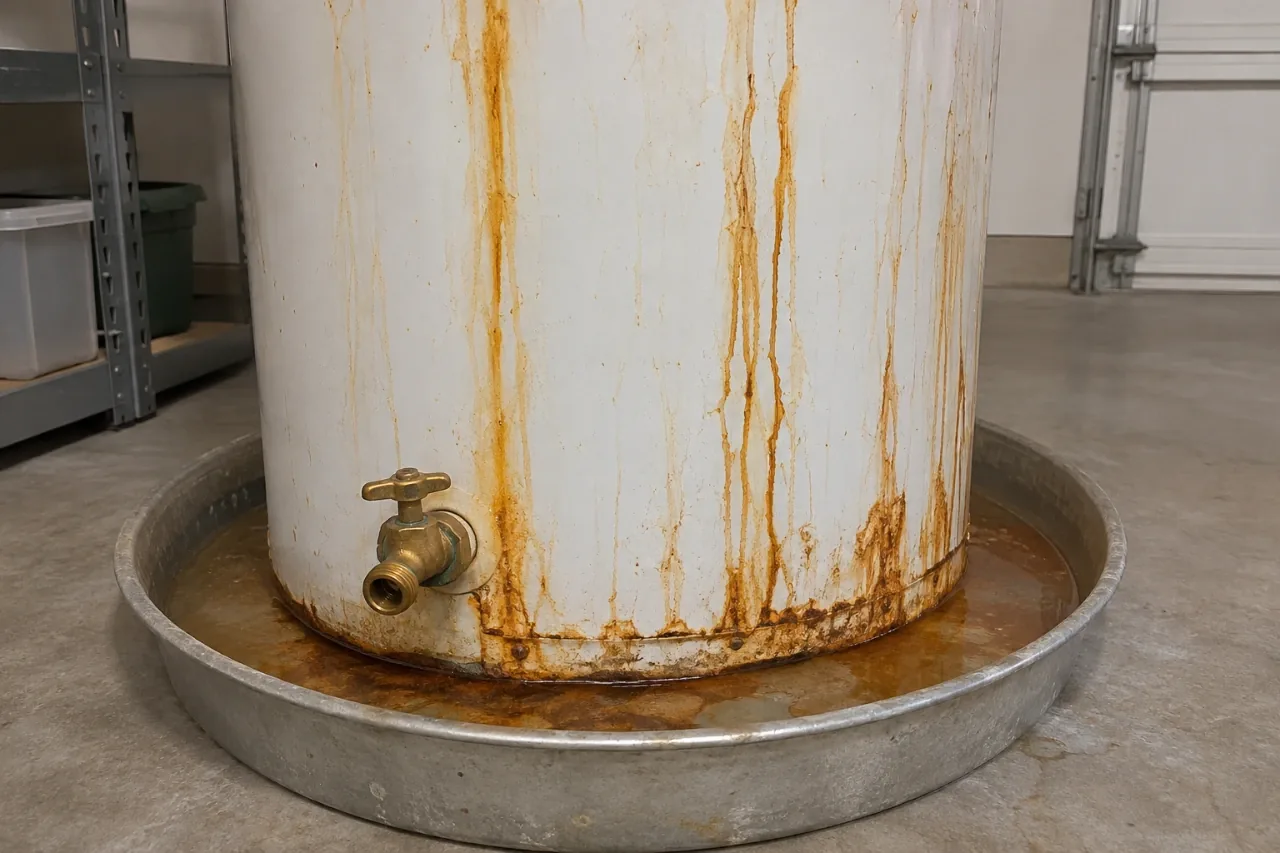
| Rusty hot water | A spent anode rod or corrosion inside the tank. If cold water runs clear and hot water doesn't, look at the heater. |
| Water dripping from the relief pipe | Excess pressure or temperature, a failing relief valve, or thermal expansion with nowhere to go. Don't cap the pipe. |
Checks that are safe to make yourself
- Check the breaker for an electric heater. If it's tripped, you can reset it once. If it trips again, leave it off.
- Check the gas. Is the valve on the gas line to the heater open, in line with the pipe? Do other gas appliances work? On propane, check the tank gauge.
- Read the label. The manufacture date and model number tell the contractor a lot before they arrive. Take a photo of it.
- Look at the thermostat setting on a gas unit's control knob. Someone may have turned it down. The Consumer Product Safety Commission's recommended setting is 120°F.
- Look at the floor and pan. Note whether water is coming from a fitting at the top, the relief pipe or the tank's base.
Leave the covers on. Electric water heaters run on 240 volts behind their access panels, and gas valves and burners are not do-it-yourself parts.
The rotten-egg smell
If only the hot water smells like rotten eggs, the water heater is a likely source. The Minnesota Department of Health explains that the odor is hydrogen sulfide gas, which can be produced by sulfur bacteria or chemical reactions inside water heaters, and that many water heaters have a magnesium anode rod. Its suggested fixes include a replacement anode that "may provide corrosion protection without contributing to the production of hydrogen sulfide gas," or a temporary high-temperature treatment, which it warns can be dangerous. Both are jobs for a contractor.
Palm Coast's city water is treated with chloramine, according to the 2025 water quality report, and the city periodically switches to chlorine for a while for extra microbial control. Either way, a smell that shows up in both hot and cold water points away from the heater, and toward a question for the utility.
Sediment and the anode rod
Palm Coast's water has a total hardness of 100 parts per million, or 5.8 grains per gallon, per the city's 2025 report: "moderately hard" on the scale on the U.S. Geological Survey's website. Some of those minerals settle in the bottom of the tank, which causes the popping noise and takes up space that should hold hot water.
The Insurance Institute for Business & Home Safety advises flushing the tank every 6 months to remove sediment, noting that sediment builds faster in hard water, and having a professional inspect the anode rod at least once every 2 years, and every year once the warranty has expired. The rod corrodes on purpose to protect the tank; once it's gone, the tank is next. See Palm Coast water.
Repair or replace?
Some repairs are routine at almost any age: a heating element, a thermostat, a relief valve, a gas control on a newer unit. Others are a signal to stop putting money into the tank:
- The tank itself leaks. No repair fixes a tank wall.
- It's past 10 years old. UF/IFAS Extension says most water heaters last 10 to 15 years and that replacing one over 10 years old may pay for itself in lower bills.
- It's had more than one repair recently, or the repair would cost a large share of a new unit.
- It's in a spot where a failure would do real damage, like a closet over carpet or flooring. IBHS says three out of four water heaters fail before 12 years.
A good contractor will tell you which way they'd go and why. See replacement and cost.
Repair questions
Why is my hot water lukewarm?
On an electric tank, a failed lower or upper element or thermostat is a common cause. On any tank, heavy sediment or a broken dip tube can do it. A thermostat turned down is the easiest thing to rule out.
Is a dripping relief valve dangerous?
It's a warning, not something to plug. The valve may be failing, or it may be releasing excess temperature or pressure. Florida's plumbing code says the relief valve can't be relied on to handle thermal expansion, so the cause needs to be found.
Can sediment be flushed out of an old tank?
Sometimes. On a tank that's never been flushed, a lot of sediment can clog the drain valve. Ask the contractor whether flushing still makes sense for yours.
How do I find my water heater's age?
Look at the rating plate on the side. Some show the manufacture date outright; others encode it in the serial number, which the maker's website or the contractor can decode.
Related pages
Sources
- Minnesota Department of Health, Hydrogen Sulfide and Sulfur Bacteria in Well Water (2023)
- City of Palm Coast, 2025 Annual Water Quality Report
- U.S. Geological Survey, water hardness FAQ
- Insurance Institute for Business & Home Safety, water damage prevention pamphlet, undated (via the Connecticut Insurance Department)
- UF/IFAS Extension, Energy Efficient Homes: Water Heaters (FY1025, 2025)
- U.S. Consumer Product Safety Commission, Tap Water Scalds (Document 5098)
- International Code Council, Florida Building Code, Plumbing, 9th Edition (2026), Chapter 5 sample
Water heater acting up?
Call or send a short request, and it goes to one independent local contractor in the Palm Coast area.